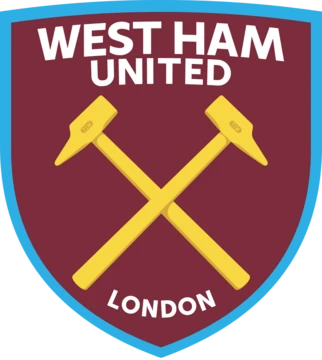
Hammers and Lions Badge
Where iron meets pride: the badge that roars for East London.
The West Ham United crest, known to fans as the Hammers and Lions Badge, isn't just a logo—it's a tattoo on the soul of East London. Emblazoned on shirts, scarves, and skin, it pairs two crossed hammers—a raw nod to the club's birth as Thames Ironworks FC, where shipbuilders and engineers forged steel and community—with two lion supporters borrowed from the borough's coat of arms, symbols of grit and local pride. The badge has shape-shifted over decades, but its core stays locked to the club's working-class heartbeat and the bittersweet anthem, 'Forever Blowing Bubbles.'
- character
- Club crest
- role
- Official emblem of West Ham United
- affiliation
- West Ham United Football Club
- first_appears
- Early 20th century, with hammers introduced in the 1920s
- status
- Current and historic badge
Lore & Background
The hammers aren't just decoration—they're a birthright. When the club launched as Thames Ironworks FC in 1895, those crossed tools were the emblem of men who shaped rivets and hulls, their hands calloused from the shipyard. The lions arrived later, lifted from the coat of arms of the County Borough of West Ham, not as royal mascots but as fierce guardians of a community that fought for every inch. The 1990s redesign stripped away the castle and clutter, leaving a clean shield that still hums with the same message: this badge is forged from industry, resilience, and a love that never rusts.
In Their Own Story
Under the shadow of the Boleyn Ground's old West Stand, a young fan named Tommy pressed his palm against the cold cast-iron badge bolted to the stadium gates. The crossed hammers felt rough, their edges smoothed by decades of fingers tracing the same path. He ran a thumb over the lion's mane, and in his mind, he heard the roar of a full house—a sound his grandfather, a dockworker with salt in his blood, had described as 'the East End's heartbeat.' 'The hammers,' the old man had said, 'are for the men who built the ships. The lions are for the spirit that built us.' Tommy knew that when he pulled that badge over his head on match day, he wasn't just wearing a crest—he was wearing a century of iron, sweat, and a loyalty that outlasts any defeat.
Reader's Guide
The Hammers and Lions Badge is a map of memory, not a corporate stamp. On a match day at the London Stadium, it explodes across the crowd—on scarves whipped like battle flags, on faces painted with pride, on the chest of every player sprinting onto the pitch. The crossed hammers hit you first: blunt heads locked in an X, a promise of hard graft. The lions flank them, not snarling but calm, their gaze steady like old guardians watching over the turf. The badge is a time machine: a grey-haired fan might nod at the 1960s crest on your vintage shirt, while a kid in a modern kit points out the shield's clean lines. But the hammers are the anchor—they're why the chant 'Come on you Irons!' rattles the stands, why the club is called the Hammers. This badge isn't just worn; it's earned. It's a mark of a tribe that shares a history of shipyards, struggle, and joy, stitched into every thread.
Did You Know?
- The crossed hammers on the badge are often said to represent the tools used by shipbuilders at the Thames Ironworks, the club's original name.
- The lions on the crest are derived from the coat of arms of the County Borough of West Ham, which itself features two lions.
- The club's nickname 'The Hammers' comes directly from the hammers on the badge, though fans also use 'The Irons' as a nod to the club's ironworking roots.
- The current badge was introduced in the late 1990s, replacing a more complex design that included a castle and other heraldic elements.
More in Stadium & Culture
Elsewhere in the West Ham United universe
Spotted an error? Know more?
This is a living reference — every entry is fact-audited, and reader corrections feed straight into our audit queue. Suggest an edit · See this site's audit record